

Automation risk comparison for job roles is defined as the process of evaluating how susceptible each role's specific tasks are to being performed by AI or robotic systems. This is not the same as predicting job elimination. When you compare job roles by automation risk, you measure task-level exposure, not just job title vulnerability. OpenAI research identifies 18% of roles at high automation risk, while 46% face less immediate disruption. That gap exists because automation hits tasks unevenly, not roles wholesale. Understanding where your role falls on that spectrum is the foundation of any serious career planning in 2026.
How is automation risk measured and compared across job roles?
Automation risk is measured through two distinct approaches: role-level scoring and task-level analysis. Role-level scoring assigns a single vulnerability number to a job title based on its general characteristics. Task-level analysis breaks a role into its component duties and scores each one separately. Task-level analysis is more accurate, and the difference matters significantly when you are making career decisions.

The most widely used data sources for job automation risk analysis include O*NET, which catalogs task descriptions for thousands of occupations, and research from institutions like McKinsey and Goldman Sachs, which model economic exposure by sector. Anthropic's labor market research adds a critical refinement: augmentation counts as only half the risk of full automation when calculating actual economic disruption. That weighting changes how you should read any composite score you encounter.
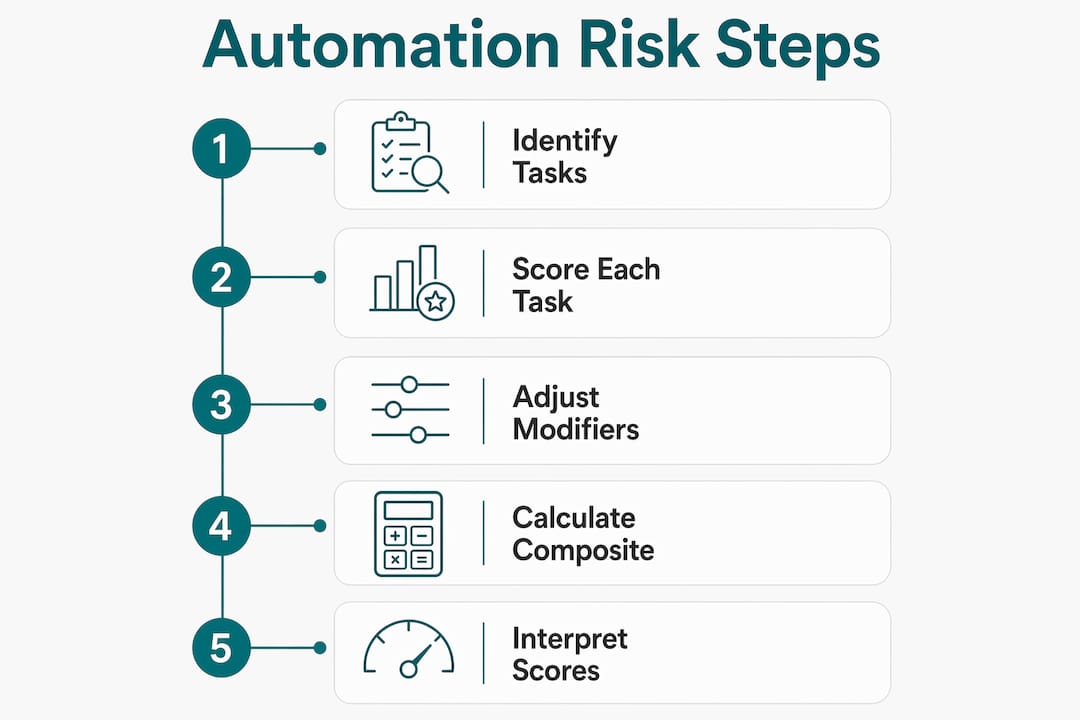
Composite automation risk scores typically combine two inputs:
- Industry exposure value: How much of the sector's workflow AI tools currently touch
- Task substitutability score: How easily each specific task can be replicated by current AI systems
- Modifier adjustments: Factors like AI tool adoption rate, seniority level, and wage band that shift the final score up or down
Composite risk scores reflect sector exposure plus task mix, adjusted by these modifiers for accurate forecasting. A senior financial analyst and a junior data entry clerk may share the same job family but carry very different composite scores once modifiers are applied.
| Scoring Method | Strength | Limitation |
|---|---|---|
| Role-level score | Fast, easy to compare | Misses within-role task variance |
| Task-level score | Granular and accurate | Requires detailed task inventory |
| Composite score | Balances both inputs | Quality depends on modifier accuracy |
Pro Tip: When reading any published automation risk ranking, check whether it uses role-level or task-level methodology. Role-level scores can overstate risk for senior professionals and understate it for junior roles with repetitive duties.
Aijobriskcheck uses a task-level approach anchored to federal occupational data. You provide your job title and describe how you actually spend your time. The platform then calculates an AI Job Risk Score from 0 to 100, reflecting your real workflow rather than a generic title.
Why job titles mislead automation risk assessments
Job titles are poor proxies for automation vulnerability. Two people with the title "Marketing Manager" can have radically different risk profiles depending on whether they spend their days writing strategy documents or pulling performance reports from dashboards.
Task-level analysis reveals significant variance within role families, and generic role-level scores can mislead risk assessments. INOP's taxonomy of 40,000+ roles demonstrates that displacement estimates shift dramatically once you decompose a title into its actual duties. A financial analyst whose work centers on client relationship management faces far lower automation exposure than one whose day is dominated by data processing. Financial data-processing tasks are up to 70% automatable, yet the analyst role is shifting rather than disappearing because judgment and communication tasks remain human-dependent.
Here is what task decomposition typically reveals across common roles:
- Administrative assistants: Calendar management and data entry score high; stakeholder communication and judgment calls score low
- Software engineers: Boilerplate code generation scores high; architecture decisions and cross-team coordination score low
- HR managers: Screening and scheduling score high; conflict resolution and culture work score low
- Nurses: Documentation tasks score high; physical care and patient advocacy score very low
"Effective automation risk assessment requires task-level audits with subject matter experts for precision. Generic role scores are a starting point, not a conclusion."
INOP workforce research
AI literacy also shifts a role's ongoing risk profile. Harvard Business School research confirms that AI augments roles demanding domain expertise, increasing demand for AI literacy and human-AI collaboration skills. A professional who actively uses AI tools in their workflow moves into an augmented role category, which carries meaningfully lower displacement risk.
How to map your job duties to automation risk step by step
Mapping your own role or your team's roles to automation risk follows a clear process. Each step builds on the last, and skipping steps produces unreliable results.
-
List every task you perform regularly. Write out every recurring duty, from weekly reports to daily emails to quarterly presentations. Aim for 10–20 distinct tasks. Vague entries like "manage projects" should be broken into specific actions: "write project briefs," "run status meetings," "update timelines."
-
Estimate time allocation per task. Assign a percentage of your working week to each task. This step is where most professionals discover surprises. Many assume their high-skill work dominates their time, but administrative and repetitive tasks often consume 30–40% of actual hours.
-
Score each task for automation susceptibility. Rate each task on a scale of 1–10 based on three criteria: whether it follows a predictable rule set, whether it requires physical presence, and whether it demands social or ethical judgment. Tasks scoring 7 or above on the first criterion and low on the other two are high-risk.
-
Apply modifiers to each task score. Adjust raw scores based on your seniority (senior roles carry lower risk due to judgment requirements), your current AI tool adoption level, and your industry's regulatory environment. Physical presence requirements and regulatory oversight both reduce effective automation risk.
-
Calculate a weighted role score. Multiply each task's susceptibility score by its time allocation percentage, then sum the results. This gives you a single weighted exposure number that reflects your actual workflow, not just your title.
-
Compare scores across roles or career paths. Once you have weighted scores for multiple roles, rank them. Roles scoring above 60 on a 100-point scale warrant active upskilling plans. Roles scoring below 30 are relatively stable but should still be monitored annually.
Pro Tip: Run this exercise for two or three roles you are considering moving into, not just your current one. Comparing target roles by automation exposure before a career change gives you a concrete data point most job seekers ignore.
Active AI users shift to augmented roles at higher rates, reducing displacement risk by approximately 8 percentage points. That is a measurable career advantage from a behavioral change you can make today.
| Role type | Typical weighted score | Primary risk driver |
|---|---|---|
| Data entry clerk | 75–85 | Rule-based, repetitive tasks |
| Financial analyst | 45–65 | Data processing vs. judgment mix |
| HR generalist | 35–55 | Screening tasks vs. culture work |
| Registered nurse | 15–30 | Physical care and patient advocacy |
| Software architect | 25–40 | System design and cross-team judgment |
Common misconceptions when comparing automation risk across roles
The most damaging misconception is treating an automation risk score as a job loss prediction. A score of 70 out of 100 does not mean a 70% chance of unemployment. It means 70% of that role's current tasks are technically automatable. Whether those tasks actually get automated depends on cost, regulation, organizational readiness, and dozens of other factors.
More than 25% of work content in management, administrative, creative, legal, financial, engineering, and IT roles is automatable, while face-to-face service and industrial roles remain under 10%. That statistic describes technical capability, not deployment reality. The gap between what AI can do and what organizations actually implement is wide and slow to close.
"80% of AI's value in enterprise settings comes from workflow and decision-making changes, not from the software itself. Human factors determine how much automation actually lands."
Apromore, The 80/20 Rule of Enterprise AI
Three other misconceptions consistently distort automation risk comparisons:
- Augmentation is not elimination. A task that AI assists with is not the same as a task AI replaces. Augmented tasks still require human oversight, quality control, and contextual judgment.
- Hybrid roles are the most resilient. Hybrid roles combining technical and judgment tasks face the slowest displacement rates. Pure execution roles face the fastest.
- Economic and implementation gaps moderate real impact. Even highly automatable tasks persist in organizations that lack the budget, talent, or change management capacity to deploy AI effectively.
Physical presence and regulatory requirements also shield entire role categories. Teachers, nurses, and social workers carry low effective automation risk not because their tasks are technically complex, but because their work is legally and socially constrained in ways AI cannot satisfy.
Key Takeaways
Comparing job roles by automation risk requires task-level analysis, not title-level scoring, because two professionals with the same job title can carry dramatically different exposure based on how they actually spend their time.
| Point | Details |
|---|---|
| Task-level analysis beats title scoring | Break roles into specific duties and score each one to get an accurate exposure picture. |
| Composite scores need modifier adjustments | Seniority, AI tool adoption, and regulatory environment all shift a role's effective risk score. |
| Augmentation differs from elimination | AI assisting a task reduces workload but does not remove the role; only full replacement raises displacement risk. |
| Hybrid roles carry the most resilience | Roles mixing technical execution with judgment and communication face the slowest displacement rates. |
| Active AI adoption reduces risk | Professionals who use AI tools in their daily workflow reduce their displacement risk by approximately 8 percentage points. |
Why I think most professionals are comparing automation risk the wrong way
I have reviewed a lot of automation risk assessments over the years, and the pattern is consistent: professionals look up their job title on a published ranking, see a number, and either panic or relax. Both reactions are usually wrong.
The title-level approach misses the most important variable, which is how you personally spend your time. Two project managers at the same company can have wildly different risk profiles based on whether one spends 60% of their week in stakeholder meetings and the other spends 60% building spreadsheet models. The spreadsheet-heavy one is far more exposed, regardless of what any published ranking says about "Project Manager" as a category.
What I find genuinely useful is the task-time audit. Spend 20 minutes listing your actual weekly duties and estimating hours. Then ask, honestly, which of those tasks follow a predictable rule set that a well-prompted AI could replicate. The answer is usually more revealing and less alarming than any generic score.
The other thing I would push back on is the idea that a high automation risk score is a verdict. It is a signal to act, not a forecast of loss. Professionals who adopt AI tools, shift toward judgment-heavy work, and build domain expertise in areas where AI still struggles are the ones who convert a high-risk profile into a resilient one. The task-level risk assessment framework exists precisely to show you where to focus that effort.
— Brooke
Your next step: get a task-level risk score for your role
Generic automation rankings tell you where your job title sits in a broad category. Aijobriskcheck tells you where your actual workflow sits, based on the tasks you perform and the time you spend on each one.
The AI Job Risk Score runs from 0 to 100 and reflects your real exposure, not a title average. You describe how you spend your time, and Aijobriskcheck matches that against federal occupational data and current AI capability benchmarks. The result is a plain-language report that identifies which of your tasks are most exposed and which give you the most career stability. You can also view a sample report before committing, so you know exactly what the analysis covers and how the scoring works.
FAQ
What does it mean to compare job roles by automation risk?
Comparing job roles by automation risk means evaluating how much of each role's specific tasks can be performed by AI systems, then ranking or contrasting those exposure levels across different positions. Task-level analysis produces more accurate comparisons than title-level rankings.
Which jobs are at the highest risk of automation?
Roles dominated by rule-based, repetitive tasks, such as data entry, basic financial processing, and administrative scheduling, carry the highest automation exposure. OpenAI research identifies 18% of roles as high-risk, concentrated in predictable, structured work.
Why do job titles mislead automation risk assessments?
Two professionals with the same title can have very different task mixes, and automation risk follows tasks, not titles. INOP's 40,000+ role taxonomy shows that displacement estimates shift significantly once a role is decomposed into its actual duties.
How does AI tool adoption affect my automation risk score?
Professionals who actively use AI tools in their daily workflow shift into augmented role categories, which carry lower displacement risk. Research shows active AI users reduce their displacement risk by approximately 8 percentage points compared to non-adopters.
What is the difference between automation augmentation and automation elimination?
Augmentation means AI assists with a task while a human retains oversight and judgment. Elimination means AI fully replaces the task with no human involvement. Anthropic's research weights augmentation at half the economic disruption of full elimination when calculating actual labor market impact.