

AI job security indicators are metrics that measure how much of your daily work AI can automate, augment, or fundamentally change. These indicators go by several names in research literature, including “AI exposure scores,” “task displacement indices,” and “automation risk ratings,” but they all measure the same thing: the degree to which AI affects specific job tasks rather than job titles. According to BCG, 50%–55% of U.S. jobs are being reshaped by AI right now, with daily tasks changing even when job titles stay the same. That finding reframes the entire conversation. The real question is not whether your job disappears but which parts of it will look completely different in two years.
What do AI job security indicators measure?
AI job security indicators measure task-level automation potential, not whole-job elimination. Researchers break a job into its component tasks, then score each task based on whether current AI can perform it reliably. The result is an exposure value, a number that tells you how much of your workday sits within AI’s reach.

The two most widely used methodologies are ONET task decomposition and observed exposure scoring. ONET, the federal occupational database maintained by the U.S. Department of Labor, catalogs hundreds of tasks per occupation. Researchers map each task against AI capabilities to produce a displacement or augmentation score. Observed exposure goes further: it tracks how AI is actually being used in real workplaces, not just theoretically. The Aijobriskcheck workflow exposure calculator applies a similar task-level approach, connecting your specific daily activities to federal occupational data to produce a personalized AI Job Risk Score from 0 to 100.
Three core concepts appear in every credible indicator framework:
-
Substitution: AI performs the task instead of you. Routine data processing, form completion, and basic report generation fall here.
-
Augmentation: AI assists you with the task, making you faster or more accurate. Complex analysis, writing, and research often land in this category.
-
Bimodal task structure: A single job contains both highly automatable tasks and tasks that resist automation entirely. About 36.5% of occupations show this split pattern, which means a job can score high on exposure while still requiring irreplaceable human judgment.
Pro Tip: When you read an AI exposure score for your occupation, ask whether it reflects substitution or augmentation. A high augmentation score signals opportunity, not threat.
Which jobs face the highest AI exposure right now?
Specific occupations carry measurable displacement risk based on current AI capabilities. Anthropic’s research found that computer programmers carry a 74.5% displacement risk, customer service representatives 70.1%, and data entry keyers 67.1%. These numbers reflect the proportion of core tasks that AI can already perform at a professional level.
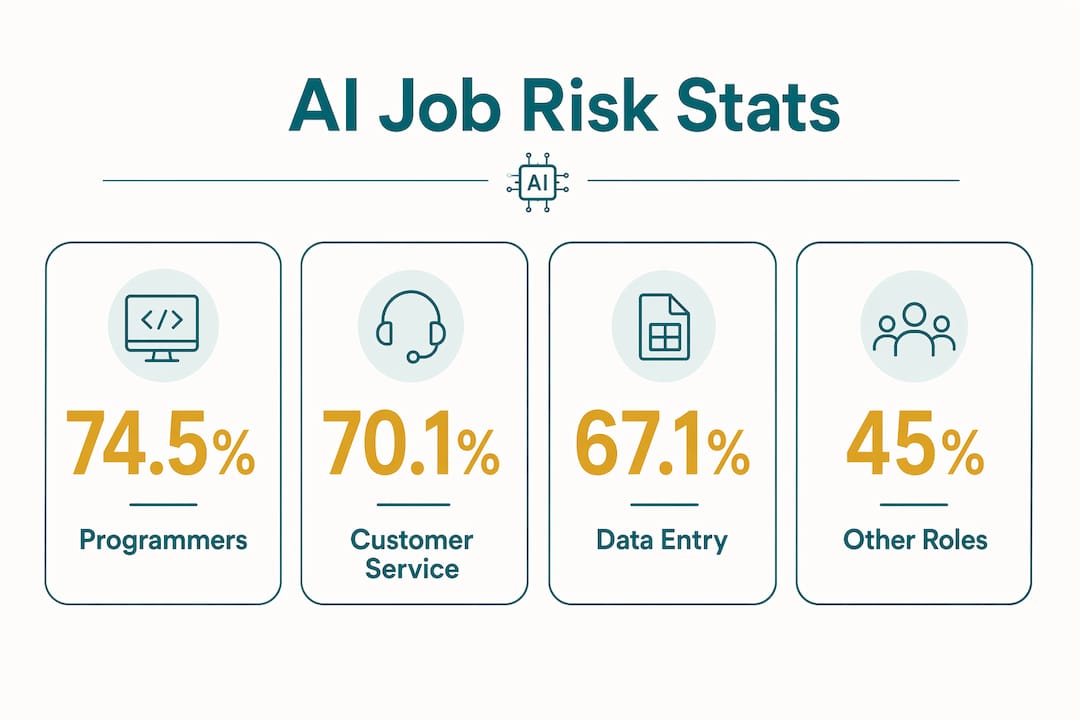
| Occupation | AI Displacement Risk |
|---|---|
| Computer programmers | 74.5% |
| Customer service representatives | 70.1% |
| Data entry keyers | 67.1% |
The labor market impact is already visible in hiring patterns. Hiring into high-exposure roles for workers aged 22–25 dropped about 14% after ChatGPT’s release, even though widespread unemployment in those roles has not materialized. That gap between reduced hiring and stable employment tells you something important: companies are getting more output from existing workers rather than adding headcount.
Firm size shapes exposure unevenly. Large firms with 250 or more employees adopt AI at a 37% rate, compared to 20% at firms with fewer than 100 employees. If you work at a large organization, your tasks are more likely to be affected sooner. The share of jobs where AI handles at least 25% of tasks rose from 36% in early 2025 to 49% by march 2026. That is a 13-percentage-point shift in roughly one year.
Pro Tip: Your industry and employer size matter as much as your job title. A customer service rep at a Fortune 500 company faces a different timeline than the same role at a 30-person firm.
What are the limits of AI job security indicators?
AI job security indicators are signals, not forecasts. The ILO explicitly advises that these indicators should not be read as precise job loss predictions. They show where change is happening, not when it will arrive or how severe it will be.
Several factors that indicators typically miss:
-
Economic feasibility: Automating a task is technically possible long before it becomes cost-effective for most employers.
-
Business decisions: A company may choose to redeploy workers rather than eliminate roles, regardless of what the exposure score says.
-
Policy and regulation: Labor laws, union agreements, and government policy can slow or redirect AI adoption in ways no indicator captures.
-
Institutional inertia: Large organizations change slowly. A high exposure score today may not translate into role changes for three to five years.
Legal oversight adds another layer of complexity. AI systems that rank, score, or evaluate workers fall under high-risk regulations in multiple jurisdictions, requiring human oversight despite vendor disclaimers. Regulators classify any AI producing hiring or firing recommendations as high-risk, meaning strict oversight requirements apply regardless of how the tool is marketed. If your employer uses AI to evaluate your performance, you have a right to ask about the human review process behind those scores.
Algorithmic bias is a real concern here. AI evaluation tools trained on historical data can encode past discrimination into future decisions. That is not a hypothetical risk. Employment law experts now routinely advise workers to seek transparency about how AI-generated scores influence performance reviews and promotion decisions.
How can you use these indicators to build career resilience?
Understanding your exposure score is the starting point, not the finish line. The practical value of AI job security indicators comes from what you do with the information. BCG’s analysis confirms that roles requiring complex human judgment and emotional or interpersonal skills tend to be augmented rather than replaced. That finding gives you a clear direction for skill development.
Here is a four-step approach for turning indicator data into career action:
-
Map your tasks, not your title. List every task you perform in a typical week. Assign each one a rough automation likelihood based on whether it involves pattern recognition, data processing, or human judgment. This exercise alone reveals where your time is most and least exposed.
-
Identify your augmentation opportunities. Tasks that AI can assist with but not replace are your highest-value targets. Learning to use AI tools for research, drafting, or analysis makes you faster without making you redundant.
-
Build skills AI cannot replicate. Complex negotiation, stakeholder management, ethical reasoning, and creative problem-solving remain difficult for AI to perform reliably. Investing in these areas raises your floor, not just your ceiling.
-
Monitor your employer’s AI policy. Ask HR or your manager directly about “human-in-the-loop” practices. Knowing whether AI scores influence your performance review gives you the context to respond appropriately.
Workers who use AI tools in more automated ways report greater optimism about job security and future pay than those who resist or passively use AI. That correlation is not coincidental. Active engagement with AI tools builds familiarity, which reduces anxiety and increases adaptability. Over a third of knowledge workers surveyed expect significant task changes in their roles. The professionals who treat that change as a signal to act, rather than a threat to fear, position themselves ahead of the curve.
Pro Tip: Ask your employer directly whether any AI system scores or ranks your work. Under current high-risk AI regulations, you are entitled to know, and that knowledge helps you advocate for fair evaluation.
Key Takeaways
AI job security indicators measure task-level automation risk, and professionals who understand their exposure score and act on it are better positioned to adapt than those who ignore it.
| Point | Details |
|---|---|
| Indicators measure tasks, not titles | Your job title tells you little; your daily task mix determines your actual AI exposure. |
| 50%–55% of jobs are being reshaped | Most AI impact shows up as changed tasks, not eliminated roles, according to BCG research. |
| High-exposure roles are already shifting | Hiring into computer programming and customer service dropped 14% post-ChatGPT despite stable employment. |
| Indicators have real limits | They exclude economic feasibility, policy factors, and employer decisions, so treat them as signals, not certainties. |
| Active AI use builds resilience | Workers who engage with AI tools report higher optimism about job security and future career prospects. |
What I’ve learned from watching professionals misread these indicators
The most common mistake I see is treating a high exposure score as a countdown clock. It is not. A 70% displacement risk for customer service representatives does not mean 70% of those workers lose their jobs next year. It means 70% of their core tasks are technically within AI’s reach today. Those are very different statements.
The professionals who handle this well share one habit: they get specific. They do not ask “Is my job at risk?” They ask “Which three tasks I do every Tuesday could AI handle better than me?” That shift from abstract fear to concrete analysis changes everything. It turns a threatening number into a work plan.
What concerns me more than the exposure scores themselves is the gap in awareness. Many professionals have never seen their own task-level data. They rely on headline statistics about their occupation and assume the worst or the best, neither of which is accurate. Tools like Aijobriskcheck exist precisely to close that gap, connecting your actual workflow to federal occupational data so the score reflects your work, not a generic job description.
The other thing I would push back on is the idea that augmentation is automatically safe. Being augmented means your output expectations rise. If AI makes you twice as fast, your employer may expect twice as much. That is a real pressure worth preparing for, not just a reassuring alternative to displacement.
— Brooke
Your next step with AI Job Risk Check
Knowing that AI job security indicators exist is useful. Knowing your own score is better.
Aijobriskcheck calculates a personalized AI Job Risk Score from 0 to 100 based on your actual job tasks, not just your title. You describe how you spend your time, and the platform maps that against current AI capabilities and federal occupational data. The result is a plain-language report that shows which tasks face the highest exposure and where your skills provide the most protection. You can review a sample risk report to see exactly what the analysis covers before you commit. For professionals who want to move from uncertainty to clarity, the workflow exposure calculator is the most direct path there.
FAQ
What are AI job security indicators?
AI job security indicators are metrics that score how much of a job’s tasks AI can automate or augment. They are based on task-level analysis, not job titles, and signal where change is occurring rather than predicting exact job losses.
How accurate are AI displacement risk percentages?
Displacement percentages reflect technical automation potential, not guaranteed outcomes. The ILO cautions that these figures exclude economic feasibility, employer decisions, and policy factors, so they should be read as directional signals rather than precise forecasts.
Which jobs have the highest AI exposure right now?
Computer programmers (74.5%), customer service representatives (70.1%), and data entry keyers (67.1%) currently show the highest AI displacement risk based on Anthropic’s task-level research.
Does a high AI exposure score mean I will lose my job?
A high score means a large share of your tasks are technically within AI’s reach, not that your role will be eliminated. BCG research shows most AI impact reshapes jobs rather than replacing them outright.
How can I reduce my AI employment risk?
Focus on tasks requiring complex judgment, emotional intelligence, and interpersonal skills, since these resist automation. Actively using AI tools in your workflow also correlates with greater optimism about job security and future career prospects.